Thursday, December 22, 2011

life and society | on perfection


Suanne is a dogged doodler, inveterate word-player, and experimental baker. An accidental Business student (bizwords.tumblr.com) with origins in English Literature, she has had the dubious privilege of toting Shakespeare into Finance class. She blogs occasionally and abstractedly at thickrett.tumblr.com.

---
On Perfection
Suanne Chan


Coming home one Saturday afternoon, Mynah saw the old man with the white beard. He was standing next to the vegetable plot. His cotton-white beard jutted awkwardly forward out of a round face, and his balding head glowed in the sun. He was rooting awkwardly among the potatoes. What was he looking for?

Mynah tiptoed over and peered over his shoulder. Sun-spotted, his hands were covered with gray dust from the potatoes as he examined each one. Out of the corner of one eye he spotted Mynah and nodded.

“This one has an eye sprouting,” he said, by way of conversation, tossing a potato into a pail. “And this one… this one looks green.”

“They all look the same to me,” said Mynah. “Maybe some are just older or rounder or lumpier than others.”

“Oh but they are different, they all are,” he replied. “I’ve been searching all my life for the perfect potato. It should be regularly shaped. Clear skin, no blemishes or scars. Unbruised and new and earthy.”

“And what will happen when you find one?” A pause.

“I guess I’ll die happy.”

*****

I’ve been thinking about perfection a lot lately. I read somewhere once that there are two kinds of people in this world: the satisficers, and the maximisers. Satisficers work towards satisfying the needs of the job at hand, while Maximisers tend to work towards perfection. Our attitudes towards the ideal standard have implications for everything in life, from design, to ethics, to relationships.

So what is ideal? For the purposes of this post, I’m going to place the to-be-or-not-to-be-perfect dilemma within two contexts: nature, and Christmas. Let’s start with nature: in my pseudo-fable I was thinking about picking fruit or vegetables at the market. There is always that tension between finding something perfect, and something acceptable. In these days of agricultural sophistication, anything too perfect can also be suspect. (The picture-perfect peach you’re holding was probably sprayed with pesticides.) If we really think about ideals of beauty, most of us would probably cite nature as the golden standard. There is liberty inscribed into each toss of branches, each sliver of sea, even that droop of mangroves. There’s always an inspired quality to nature that makes me pick up a shell or flower or leaf and want to take it home. A wild abandon that is not lost because this petal is more ruffled or that leaf more tilted than its companion. Sometimes, looking at nature I am reminded that God never meant for us to compare ourselves with our own kind. Just before Jesus died the disciples were arguing among themselves about who was greater. “The greatest among you,” he said, “must be the servant of all.” For the quality of a thing is not in what it is, but in what it was made to do. And in the act of dying a fruit brings forth—well, fruit.

And then there is the incarnation. What does it mean that a thing could take on a new quality, become something else? I’m sure that plastic surgeons and makeup artists have their take on this. But Christmas tells us that what is ideal is not just the perfection of something put on, but also the rawness and vulnerability of something taken off. A God putting on flesh, but a God stripped of the power to save himself from torture, and mockery, and death.

And something more: like the old man in my story, Simon in the gospel of Luke saw in Jesus the perfection he’d been waiting for all his life—“Now I can die happy” he said (Luke 2). Was Jesus perfect the way you and I tend to think? By no means. But well, the Bible talks about him as a branch, a plant. Not even a particularly attractive plant.


For He shall grow up before Him as a tender plant,
And as a root out of dry ground.
He has no form or comeliness;
And when we see Him,
There is no beauty that we should desire Him (Isaiah 53).

He wasn’t well-connected. His friends were fishermen, tax collectors (think traffic police/carpark attendants), ex-prostitutes. Along his ancestry there were adulterers (David and Bathsheba) and immigrants (Rahab from Canaan, Ruth from Moab). He was a carpenter. There is no clear thread of perfection in this, I think at first (and so did those who disbelieved his claims. Not perfection on their terms. Not the perfect one they were waiting for.). But maybe this is the point? What was pure and consistent and perfect when I really think about Jesus’ life was this: he only did what his Father told him to do. He was obedient even to the point of death (and who can live up to that!)

So what is ideal? Or maybe, a better question: what is purity, and when is the substance or person held most true to itself? As much as we are tempted to pull things to ourselves—acquisitions, sophisticated friends, lofty qualifications—we are ourselves none of these things. “Excellence is from God, perfectionism is from the devil,” I once read and now I think I’m starting to understand. Composition is a process of elimination, says my friend’s music professor.

This year end, as we work towards taking stock and clearing stock and resolutions, let’s look at the things we need to put off of ourselves—the things that smear and mar and obscure the who-we-are. Maybe true excellence is not just about strife to sharpen and hone and slap on the bells and whistles—It’s also about the being still and clear to listen for what is right and true, so that I can recognise my own hurts and scars, and the angry, jealous discord of my own life (my attitudes to my career, to my family, to my appearance), and then come to the One who has made all the amends. To be set right. Redeemed. Salvaged. Recycled. And made new.  It’s not enough for me to be enhanced; I also need to be edited.
---

"life and society" will feature various people from different walks of life and various parts of the world. New posts are up every Monday and Thursday at 6pm (GMT +8 / Singapore time) through the first week of 2012. On Monday (Dec 26), I'll be featuring Marcus Seng, an acquaintance from university who used to steal the limelight with his striking mohawk in Geography lectures in freshmen year. He is now with the Singapore Navy and works to protect the coasts of our country.

Wednesday, December 21, 2011

a confrontation

The first ostensible conversation after half of my family got home, as according to my fallible memory and as a little tribute to Tennessee Williams.

Side character: (to X) _____ left a pile of clothes in the bathroom.
X: Did you guys do laundry?
Y: _____ does it.
X: And you didn't do the laundry?
Y: (irritated) We agree on a day to wash it together after every two to three days.
X: And you have to get angry?
Y: (still upset) It's not like I don't do it. We wait for a few days before doing it and _____ is in charge.
          (The bystanders who also just got home are caught in the middle. They stand alongside X and stare at Y, puzzled.) 
X: Ha. Our personalities really don't match. We shouldn't even talk to each other.
Y: You say it as if I don't know how to do it. If ______ left a pile of clothes in the bathroom, then maybe he wants to leave it there. You have to ask him, not me.  
Same with the last time - I cooked noodles for _______ and you told her you weren't sure whether it was even cooked properly!
X: I didn't say that. I said "Don't know if the noodles are soft".
          (Y shakes her head.)  
X: Our personalities really don't match. We shouldn't even talk to each other.
          (Y shakes her head again, looking at the computer screen, making effort to look unfazed by the accusation and unpleasant talk.) 
          (Eventually, X heads for the kitchen and the side characters leave the set to go to the bedrooms. Y is the last to leave. She heads for her bedroom and closes the door.) 

Narrator: How unfortunate, that X should come home from a vacation to such an unpleasant conversation. 
And how unfortunate, that Y had to respond to seemingly harmless comments that accused. 

Family is sometimes tiring to be around. Too noisy, too messy, too crowded, too screechy, too negative...complaints and sighs abound. But that is where the boundaries of love are stretched to cover over conflicts and flaws. Humanly impossible - you have to help me, Jesus.

Tuesday, December 20, 2011

smelly gweasemas~~


Tidings of comfort and JO to my ginger kat, and to all of us who need it more than the Christmas smiles we wear on our faces.

"w00t to teh Ceiling Cat! An peace fer doodz he luffs! Kthxbai." Luke 2: 14, according to the LOLCat Bible

Monday, December 19, 2011

life and society | confessions of a christmas skeptic


Jonathan has been saved solely by the blood and the cross of Christ! He is extremely long-winded, and is in the last stage of his vocational training; his future job will roughly be equal parts clerical work, night security guard, and doing odd-jobs. He knows Daphne from campus and considers it a blessing to know her. He also hopes that you have yourself a very Merry Christmas!
---

Confessions of A Christmas Skeptic
Jonathan Sng

When Daph first told me the idea of guest blogging and the ability to select a date (!!), I was intrigued. But alas, she was talking about the temporal date and not the social, so I chose dates which were pretty close to Christmas.

Let me confess that I’m sceptical about Christmas. I’ve never Really Liked Christmas, even as a confessing christian; it has always seemed so spectacularly… Average. Before I get flamed, or denounced as a heretic, let me clarify what I mean. I do believe in the historical event of Christmas, and in the birth of our saviour. However, in terms of Christian holidays, it ranks second to Easter in my heart. In terms of celebration and festivities, Chinese New Year is slightly more exciting. For personal reflection, watchnight service/New Year’s Eve seems more appropriate. (Though arguably it is still the 6th/7th day of Christmas). Some people claim that Christmas is overhyped; some claim that its origin has nothing to do with Christianity; others claim that calling it Christmas is insensitive. I’m not going to debate about all these issues, but the reason why Christmas has never been a soft spot of mine is because it all seems so… irrelevant.

So I’ve been thinking about Christmas and its meaning. (Being pretty worldly,) I started thinking about the stuff that I was going to do during Christmas. To my horror, I realised that I had work on 26th of December. I am going to work full-time soon, and my job will need me to work on weekends and public holidays. I got to thinking about how terrible it was to work on a public holiday, and then I thought about people who were “in the same boat” (like the bus drivers and nurses and the people who keep your electricity/gas/water running and taxi drivers and basically everyone who needs to work on weekends.) Then I remembered guiltily that I had agreed to write this piece for Daphne.

But suddenly a mental connection was made, and I felt emotional. I would’ve liked to be more descriptive; but it was a mix of emotions, shock, disgust, joy and horror all rolled into one.

I started thinking about foreign workers and the incarnation.

Let’s start with foreign workers first, as it’s easier to explain. If you know daph (and I would assume so, since you read this blog), you would probably know that she has a heart for social justice and concerns, and in my interactions with her, she’s mentioned foreign workers and their plight in Singapore a few times. So as I was thinking about working on Christmas, I remembered the foreigners who are working in Singapore. I mean, I really wonder how many maids or construction or shipyard workers will get an off day during this festive season! I don’t have any friends who are foreign workers (to my shame), but given the shift-work nature of their jobs, I cannot imagine that they will get/want much time off.

What then about the incarnation? To some people, this word may seem foreign, to others very familiar (if you happen to like theology or archaic English). In a nutshell, incarnation primarily describes God becoming flesh by being conceived in the womb of a woman, and being both fully Man and fully God. This is also the Christian reason behind Christmas; that God would come down to live among man as man. 

I don’t know about you, but suddenly I saw parallels between the Christmas story, and these unlikely people who are amongst us. At the outset, I was disturbed. How could I possibly identify these foreign strangers with the holiness of the Son of God? Then I remembered Jesus; that He himself was hated, an alien, an outsider. That he experienced dereliction, isolation from his Heavenly father.  That he himself identified with the weak, saying “I'm telling the solemn truth: Whenever you did one of these things to someone overlooked or ignored, that was me—you did it to me.'” Then I remembered Christmas, that supreme act of condescension, the fullness of God clothed in frail humanity. I remembered the circumstances of his birth, the reality of the nativity scene: Not just the joy at the saviour of the world, but the fear and the uncertainty of Mary and Joseph, the real human feelings. 

Then Christmas became more real to me: no longer a mere historical story, but the raw reality of the situation coming into life. The events that I once glossed over as a single line in scripture “Because Joseph her husband was faithful to the law, and yet did not want to expose her to public disgrace, he had in mind to divorce her quietly.” became almost overwhelming.

Then I thought about the way I treat people who are different from me - especially foreigners. How we as a society treat people who are different or strange or “other”, and the cruelty we inflict on them for no reason other than the fact that they are different or strange. Worse yet, the cruelty we inflict because we are the majority, because we feel entitled, because we feel that we deserve something. I remembered the stories that I had heard from my friends: A construction worker who suffers a work injury and is shipped home before he can claim reparation; another foreign worker who is diagnosed with cancer, and is quickly sent home once he is stabilized so that he is not a financial burden to our society. Maids shipped to Batam who are ensnared by debt and sexual traffickers due to a desire by their employers to save on airfare, and a contractual loophole to send them back to their “Country of Origin” (i.e. batam), and not their location of origin.

If this is not societal injustice, then justice has no meaning. If Christ died to show us this sort of grace which we show, then grace has no meaning. 

The most galling thing perhaps, is that I am equally, if not more guilty of this hate. Of this unreasoned odium against people who are different. That I am guilty of looks which kill, and words which wound. Of actions which distance and not bring closeness. Of sly glances on public transport, a slight shift in body weight here, a subtle shuffling there, all conveying a message that “You are not wanted.” Of hushed tones, or discriminatory terms, fuelled by the madness and hate contained in my soul. 

Most galling perhaps, because I know this to be true: That it was my sins for which Christ died for; my very real and tangible sins! That even as I think accusatory thoughts of others, the darkness within my own heart condemns me. That I am guilty, and that if I had lived during the time of Jesus, save for the grace of God, I would be right there in the crowd baying for his blood.

But what grace it is! So this Christmas, even as I meditate upon the notion of Christmas, I cannot escape the cross of Christ. But I am reminded that the work that had its completion at the cross of Calvary had its beginnings in a manger in Bethlehem. That the God who has set me free and has taken my guilt has identified with my pain and humanity. 

So maybe I was wrong, maybe Christmas IS relevant, maybe Christmas IS a season of giving, of love, of remembrance of grace. Maybe it becomes applicable when I choose to remember the sacrifice of the ones (and the One), who gave so I can enjoy this season.
Here’s wishing you a very Merry Christmas and hoping that you remember the ones around us as well!
---

"life and society" will feature various people from different walks of life and various parts of the world. New posts are up every Monday and Thursday at 6pm (GMT +8 / Singapore time) through the first week of 2012. On Thursday (Dec 22), I'll be featuring Suanne Chan, one of my best friends at this point of time in my life now. Best in every sense of the word. She is a prophetic poet and very smart student with a very gentle and strong heart! 

real fasting and real celebration

This I am increasingly convicted of for the hand of God that comes with it and its eternal value.


Is not this the kind of fasting I have chosen: 
     to loose the chains of injustice   
     and untie the cords of the yoke,  
      to set the oppressed free and break every yoke?  
Is it not to share your food with the hungry     
     and to provide the poor wanderer with shelter—  
     when you see the naked, to clothe them,     
     and not to turn away from your own flesh and blood?  
Then your light will break forth like the dawn,     
     and your healing will quickly appear;  
     then your righteousness will go before you,     
     and the glory of the LORD will be your rear guard.  
Then you will call, and the LORD will answer;     
     you will cry for help, and he will say: Here am I.
Isaiah 58: 6-9 

Then Jesus said to his host, “When you give a luncheon or dinner, do not invite your friends, your brothers or sisters, your relatives, or your rich neighbors; if you do, they may invite you back and so you will be repaid. But when you give a banquet, invite the poor, the crippled, the lame, the blind, and you will be blessed. Although they cannot repay you, you will be repaid at the resurrection of the righteous.” 
Luke 14: 12-14

Sunday, December 18, 2011

going home

Don't You Worry | Lucy Rose

Feet moving on their own
We trust they'll take us home

Friday, December 16, 2011

life and society | graduate school


Sixth on the guest list is my Ecuadorian friend Alejandro whom I met at the University of Arizona almost two years ago. As with every guest, it's a privilege to have Alejandro take out time from his hectic and intense schedule to write for "life and society".

For this series, he gives insight on being a PhD student - something that most of us do not go through - that graduate school goes beyond grades to a more advanced exchange and dialogue of ideas. But it can also involve tension between people as well as the stress of institutional expectations.

---
Graduate School
Alejandro Proaño

The last couple of weeks I’ve been thinking about what to write for this posting. I was considering a wide range of topics from the beauty of Math to inter-cultural relationships. However, all my duties as a grad student kept me extremely busy for the last few days and didn’t have much time to develop one of those interesting topics, and have decided to talk about my experience as a PhD student. 

Seven years ago, as a college student in Ecuador is the first time that I wonder about graduate school. I was inspired with my professors. Brilliant minds with PhD degrees in Physics, Math, Engineering and Philosophy. These guys seemed very passionate about their careers. In my conversation with them, we would get to very interesting points in whatever topic we discuss (as a 20 year old kid, my favorite discussions were about women). Anyways, since that time I remember I wanted to pursue a PhD. I thought in graduate school, I would satisfy my intellectual curiosity while getting professional advancement. 

Now, after three years in graduate school I realized that this is not how it looked like. The first and most shocking reality I faced was to realize that grad school is not a continuation of your undergraduate studies. Let me explain. When I was an undergraduate, of course I studied hard and several times a semester there was those endless nights when you have to finish any kind of assignment. However, I always had time for fun without having to worry about any serious stuff; the only responsibility was to obtain good grades. In grad school there is a different reality. You still care about your grades, even though most of professors would give you a B even if you do terribly in the class. Moreover, you care about respect. When you talk to your professors (no more talks about women), you are treated as a peer, and are expected to have brilliant ideas and contribute to the continuous development of your field of interest. The relationship with your peers (classmates and labmates), it might not be as innocent and friendly as when you are in high school and college. These guys become your competitors. Every year you have to compete for getting funding (teaching assistantships, research assistantships, fellowships, travel grants, etc), specially in these times when university budgets are tight. When you graduate, you will compete with the very same people for jobs, internships and postdocs. Note that, there are many people that don’t manage competiveness in a healthy way, and may be willing to do crazy things to take over you. 

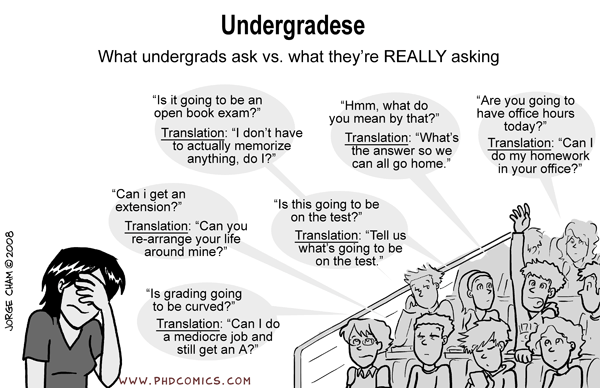
What about money? Well graduate school is not cheap. Several people come with multiple student loans. The lucky ones get a fellowship or an assistantship. With a fellowship you are in a great position, you can focus on your interests and advance at your own pace. However, assistantships can be a nightmare. Let’s talk about teaching assistants. These poor guys usually are university slaves that have to deal with more than 50 students each semester. And we all know that undergrads don’t really care about learning, they care about the grade (If you are one, no offense, I was one too). This comic illustrates my point.


On the other hand, we have the research assistants. These guys are those who were chosen by their advisors to be funded and guided in research. Translation: Other type of slaves that will be doing whatever their advisor ask them to do. Of course, this comes with a lot of frustration, which reminds me of my current situation. The last three months I’ve been working in a paper to submit it to a conference. However, the day before the deadline, after a horrible weekend of running experiments and writing the report, my advisor decided that we don’t have time to meet this deadline, and maybe we can submit for a different conference. This comic perfectly describe the moment when I asked him if he went over my paper.


Or,


Is it that bad? Well no. Graduates students have a lot of free time. Well, kind of… In reality, the life of a graduate student is sustained by procrastination. Everything is about deadlines, and of course, why to start working early when you can finish it the last few days before the deadline. So just have fun until the time comes…


All the comics are from Piled Higher and Deeper (www.phdcomics.com)

---

"life and society" will feature various people from different walks of life and various parts of the world. New posts are up every Monday and Thursday at 6pm (GMT +8 / Singapore time) through the first week of 2012. On Monday (Dec 19), I'll be featuring Jonathan Sng, a friend from my community of people who follow Jesus.